Showing posts with label Genre. Show all posts

Wednesday, 26 April 2017

CODES & CONVENTIONS OF SLASHER HORROR

Slasher movies are one of the most predominant sub-genres within the Horror category, and are highly popular amongst horror fans. Despite many slasher films having vastly different storylines, they all abide to a similar formula and abide to the same conventions.


The Killer

Of course, A killer is one of the main components of a slasher film. Although they are usually male, their identity is commonly hidden through the use of a mask, and is revealed (if at all) at the end of the film. Even if the killer's identity is known by the audience, they still keep their face hidden by the mask. This, combined with the fact that he usually has no or little dialogue, portrays the killer as having a sinister, omnipresent and threatening nature. His back-story is likely to include some sort of childhood trauma that lead him into becoming the homicidal maniac he is today, creating some sort of sympathy in the viewer, despite being aware of the horrific crimes committed by him throughout the film.


The Heroine

Although the slasher genre sometimes causes controversy for being arguably sexist, the 'heroic' role is commonly acquired by a female. It is evident to the audience that the Heroine (or The Final Girl) is conservative; she doesn't drink alcohol or take any drugs, and is most often a virgin. It is notable that a particular skill/ set of skills is possessed by the character, as this is known to help them defeat the killer in the final battle.


The Victims

The victims are one of the most substantial elements of the Slasher sub-genre, and are often teenagers, most commonly in high school, and have morals entirely unparalleled to that of the Heroine. Rarely does the killer pick off these characters specifically because of their immoral behaviour, however the unspoken code of slasher films is that they must be punished for their wrong doings. As sadistic as it may sound, fans of the genre tend to look forward to the deaths of these types of characters because they believe they deserve it.

However it isn’t always bad characters that get killed off, ultimately many characters die who, in any way, have an association with the main character. Sometimes a protagonist is killed off for shock value, for example Randy in Scream 2.


Violence

It is obvious that Slashers differ from other horror sub-genres when looking at the violence depicted throughout the films, and instead of focusing on such themes as character development, concentrate on the macabre gore. The storylines within Slashers hence allow the killer the opportunity to cause mayhem amongst the characters. The deaths are extremely graphic and bloody, and are caused by a particular weapon of the killer’s choice, for example Jason Vorhees’ iconic machete. 

History

John Carpenter's 'Halloween', made in 1978 is considered as being the first "true" slasher in terms of using all of these components within the same project, therefore setting the standard by which all other films within this sub-genre are viewed upon. 'Halloween''s success led to 'Friday the 13th' in 1980, which then opened the door for hundreds of similar during the 1980s, such as 'A Nightmare on Elm Street' containing the original and infamous villain, Freddy Krueger.
By the start of the '90s, the slasher concept had worn thin, with fewer and fewer films at the box office relating to the genre. However in 1996, Wes Craven's 'Scream', became the biggest hit the genre had ever seen, featuring all of the main codes and Conventions of the slasher sub-genre with a mildly ironic twist. 

Saturday, 17 December 2016

PROS AND CONS OF THE SLASHER SUB-GENRE

PROS AND CONS OF USING THE SLASHER SUB-GENRE

For our final coursework piece, we have decided to choose the Slasher sub genre as our main basis (with included elements of thriller horror). We picked this sub-genre to focus on as we felt that we are able to express lots of our knowledge of cinematography in general, and experiment with new techniques both in and post-production parts of making the film opening.

Of course, there are both advantages and disadvantages to this choice of sub-genre, and it is important to understand what they are before filming in order to be aware of what we need to put more focus on when filming and editing the opening.


Location

  • The codes and conventions of slasher horror feature an extensive range of location; from an everyday well known location such as a school, to a darker and more eerie one such as a forest. For our final film opening, we have decided to use a basic home setting, a dimly lit street, and an urban-style overpass, which are very easy for us to use as it is close to home and it will not cost anything extra to either travel to or use, as they are public settings all within walking distance.
  • The only problem we may face with location is mostly to do with the weather. We would ideally like to film in the evening, when everything is dark. It would be ideal for there to be quite miserable, post-rain weather, as this could count as pathetic fallacy- a common convention of the slasher genre. Of course, the weather is out of our control so we cannot decide what it will be like at the time of filming, therefore we can't guarantee a particular type of weather.

Mise en scene

  • Mise en scene is a prevalent feature within the slasher sub-genre, as it can make the audience aware of both events which could happen in the future, as well as things like character traits and what type of situation they could end up in according to the codes and conventions of the genre. Luckily, our chosen characters will be very simple to present through mise en scene; alcohol bottles, pill packets and use of simple makeup and costume are simple things which can be included using objects from around the house.
  • A problem we may face with props in mise en scene is use of weaponry when filming. The killers will have visible weaponry (handheld such as knives) which if not planned responsibly could result in members of the public wrongly assuming how we are using such items. Another problem which we could possible face is the realism of the makeup used in the film opening. If it doesn't look extremely realistic, the final piece will not look as professional as it should. To overcome this, we are going to ensure that a good amount of time is spent on planning and applying any makeup and special effects so that it looks as realistic as possible.

Thursday, 3 November 2016

CODES & CONVENTIONS OF ZOMBIE HORROR

Conventions of Zombie horror movies
Zombie movies have become increasingly popular in the last few decades.

The protagonists(humans)
Zombie movies usually have a similar approach when it comes to the protagonists. The human(s) usually have to find  a safe haven to hide in and survive the zombie infested world that they are trapped in. Normally there are a group of survivors and it is almost a certainty that at least one of them will die or become infected by the end of the film. There is usually a struggle in morality between the group on ending the life of one of the group when they become in infected.


Setting
When it comes to setting, there are a few locations that are commonly used in zombie films. The protagonist will more often than not, awake to find the town or city they are in deserted. The atmosphere is very ominous and quiet. After they have explored the setting they usually will meet a survivor or group of survivors. Aside from the deserted city, there will sometimes be a holdout where the characters have to defend themselves from the zombie onslaught, somewhere recognisable like a barn or a pub with windows that allow for gun fire to be used against the zombies... on an opportunity for them to break through. More often than not this location will be compromised and the remaining survivors have to flee.


Zombies
Obviously a zombie movie will involve some type of zombie. The living dead usually have no form of speech and a limited brain capacity. The term zombie was first introduced to the American people in 1929 as a Haitan creole for a reanimated corpse by voodoo, where it was then used in motion pictures.Different movies offer different variations of zombies such as:

Early zombies: These zombies generally remained faithful to Haitian tradition. Their skin was grey and their eyes were darkened or exaggerated. They were reanimated corpses that were used by their masters to carry out tasks and generally follow orders(though usually the master would lose this control. By the 1950's began to diverge from the standard zombie movie conventions. Experimentation with humans turning into zombies started to emerge.

Romero zombies: In 1968 George A. Romero released his directorial debut 'Night of the living dead', which revolutionised zombie movies as we know them today. Whilst he used some of the ideas from previous horror movies he introduced ideas that would remain part of  his films for the next three decades. For example the zombies had a hunger for human flesh, the zombie attacks were shown in explicit detail with a heightened extent of gore and blood, the zombies could only be killed by destroying the head/brain and the zombies infection could be spread. One major difference was the move away from voodoo and a master controlling the zombies, other traditions that also became popular that weren't necessarily founded by Romero are the slow clumsy movement, the humans fight for mere survival and the zombies infection being treated as a plague.

Modern zombies:Zombie movie conventions have been played a lot with in the 21st century. 'House of the dead' and 'Resident evil' have drawn inspiration from video games counterparts, the likes of '28 days later' and 'I am legend' have dealt with the idea of zombies as a contagion. 'Shaun of the dead' and 'Zombieland' have introduced comedy into the zombie formula. The 2004 remake of 'Dawn of the dead' introduced the idea of the zombies being agile and able to run, allowing them to chase after the humans and being a bigger threat. 

Violence and Gore
The way in which the zombies are dealt with usually involves a lot of weaponry and violence. Weapons such as guns, knives, grenades and particularly chainsaws are commonly used to stop the zombie hoard. As you can imagine this creates a lot of gore, blood splattering all over the place, disembodied limbs flying every where and horrific scenes of body horror and a staple to the genre. A great example of how gory a zombie film can get is, Peter Jacksons 'Braindead', where the main character takes out a whole hall of zombies with a lawn mower. Zombies are not the only thing that produce a lot of blood however, those that fall victim to the hoard usually are seen being ripped apart or having their organs eating, sometimes whilst still alive which can provide for some uncomfortable viewing.


Sunday, 30 October 2016

CODES & CONVENTIONS OF PSYCHOLOGICAL HORROR

Psychological Horror is one of the most popular and up-and-coming sub-genres of horror. They tend to create discomfort and fear amongst audiences through use of common psychological fears and vulnerabilities. It is argued that the psychological sub-genre is more relatable to that of the thriller genre, however the main intention when making these films is to scare the audience mentally, and making them question every-day things- thus not being a thriller.


In Psychological horror films, the 'weapons’ used are less physical objects, and tend to be more supernatural and manipulative. For example, a killer’s distorted minds and ways of manipulating their victims act as weapons of fear against the protagonists in the film. Characters’ visions and jump scares are also used as weapons of fear, instead of an antagonist actually possessing a knife, or gun etc.


It is very often that an audience will see an eerie and often abandoned setting or scene when watching a Psychological horror film, such as large gothic houses, forest and dark woodlands, abandoned schools and other (usually thriving) public facilities including hospitals etcetera. These types of settings create both a sense of fear and realism for the target audience as they are able to relate to the setting of the film as they have seen or are currently in these settings. 
This makes the audience more afraid as it is easier for them to picture themselves in these positions, and makes said settings more frightening to them when thinking about what they have witnessed as a member of the audience. Quite often within psychological horror films there is use of flashbacks which make the audience aware of why the killer is the way he/she is- disturbed; they are used to explain what happened to them previously in their lives that has lead them to become mentally distorted.


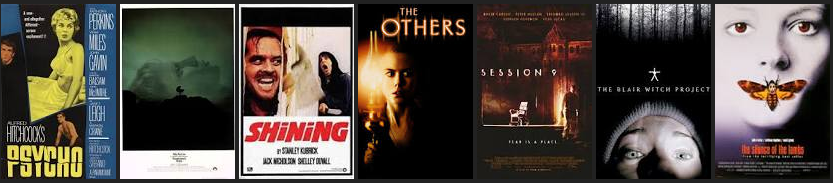
Some well renowned psychological horror films include:


•Jacob's Ladder (1990)

•The Shining (1980)

•Black Swan (2010)


Tuesday, 18 October 2016

CODES & CONVENTIONS OF HORROR

The Horror genre is and has been one of the highest viewed genres in the history of film. Despite it having an abundance of sub-genres, they all share several codes and conventions which make clear to the audience its general genre.

Horror Sub-Genres

Listed below are just some of the sub-genres related to horror.


  • Body Horror
  • Classic
  • Posssession
  • Gothic
  • Psychic
  • Psychological
  • Slashers
  • Supernatural
  • Teen Terror
  • Vampire
  • Werewolves
  • Zombie Horror


Horror in general has many specific codes and conventions both related to on-screen and off-screen.

The primary target audience for horror is from ages 16 and above, which can be seen through use of 15 and 18 age certification depending on the sub-genre of horror; for example, a Body Horror is most likely to have an age 18 certificate, due to the high levels of violence and gore- something less seen in sub-genres such as psychological and supernatural horror.

On-screen, it is made clear to the audience that horror films are commonly based in an 'every day' setting, with a (commonly) adolescent and young-adult cast. This is the case as it puts the audience into a sense of realism, as they are used to setting, adding to the general sense of fear given off by horror films due to the fact that it would be something that they are used to themselves.

In horror films, the cinematography plays an important part. There is commonly a slow pace of editing, framing and camera movement, thus building tension. Use of low key lighting, CGI and SFX are also components of the horror genre and are used in different ways to other genres, evoking a different range of emotions in the audience. There is an extensive use of close up shots within the horror genre, making viewers aware of the precise emotional state of certain characters in a particular situation. Non-diegetic sound is used frequently amongst distorted diegetic sound to both build suspense and shock the audience.
Use of hand-held camera shots are used occasionally in the horror genre, providing the audience with a sense of identification and realism in a certain scene. Point of view shots also aid this feature.

It is also made evident that there are clear binary oppositions (e.g. good & evil) in horror films, and it is a general convention that there is a dominant and hegemonic representation of gender-  victims are commonly females.