Showing posts with label 4. Show all posts

Thursday, 17 November 2016

CODES AND CONVENTIONS OF THE HORROR/THRILLER GENRE

As with all genres of film, the thriller genre contains many codes and conventions that will feature throughout. Thriller movies often revolves around a fast paced plot, with anticipation and suspense featured heavily to keep the audience on the edge of their seat, with tension usually being at the forefront of it all. Many of the conventions overlap with that of the horror genre. 

Lighting
The lighting in a horror/thriller is very important as it creates atmosphere. low-key lighting is usually used due to the different shadows and dim hue are suitable for the dark mood. It sets the tone, mood and is associated with the dangerous mystery often associated with horror thrillers. The lights are often used at eye level or from the floor. 


Editing 
Quick cuts are a technique used in editing when the shots are of a short duration and rapidly move from one to the other. It can be used to give a lot on information quickly or to create a sense of chaos. For example the saw movies use this technique a lot when the characters are stuck in their traps and the technique represents their struggle to escape. Hip hop montage: This technique uses very fast cutting to portray action through a rapid series of simple actions accompanied by sound effects.


Sound
The sound in a thriller is very important feature in order to make the audience feel on the edge of their seat. A common technique is using the music to build tension during scenes of an ominous and suspicious nature. The non digetic music can start of quiet and low pitched and as the tension in the scene builds the background music gets louder and high pitched, it is also very common for the music to increase in pace towards the climax of the scene. Digits sounds such as the creaking of floorboards and opening of a door can also be used in conjunction with silence as it can create a jump scare for the audience and place them in the character(s) on screens shoes.

Thursday, 10 November 2016

AGE CERTIFICATES

Before a film can be released to the public it must be approved by the bbfc and given an age certificate. They range from U(universal) to 18. The the number certificate means an audience member must be at least this age to view the film.


Universal

A U certificate means that the film should be suitable for every one ages 4 and upwards. Most U films are aimed at younger audiences but also cater to the parents as well. Which means that there are often hidden meanings or ideas throughout the movie that older audiences will understand. Generally these films are animations to appeal  to younger audiences   .

Language

Discriminatory language or behaviour is unlikely to be acceptable unless clearly disapproved of. Infrequent use only of very mild bad language.
 

Drugs

References to illegal drugs or drug misuse must be infrequent and innocuous, or have a clear educational purpose or anti-drug message suitable for young children.
 

Imitable behaviour

Potentially dangerous or anti-social behaviour which young children may copy must be clearly disapproved of. There is no emphasis on realistic or easily accessible weapons.

Nudity

Occasional nudity, with no sexual context.
 

Sex

Only very mild sexual behaviour (for example, kissing) and references to such behaviour.
 

Threat

Scary or potentially unsettling sequences should be mild, brief and unlikely to cause undue anxiety to young children. The outcome should be reassuring.
 

Violence

Violence will generally be very mild. Mild violence may be acceptable if it is justified by context (for example, comedic, animated, wholly unrealistic).


Parental guidance
A parental guidance certificate is for general viewing but certain scenes may be unsuitable for younger audiences(8 and under). Children of any age may be unaccompanied whilst viewing but parents may need to consider whether certain content may upset or scare the children. 

Discrimination

Discriminatory language or behaviour is unlikely to be acceptable unless clearly disapproved of, or in an educational or historical context, or in a particularly dated work with no likely appeal to children. Discrimination by a character with whom children can readily identify is unlikely to be acceptable.
 

Drugs

References to illegal drugs or drug misuse must be innocuous or carry a suitable anti-drug message.
 

Imitable behaviour

No detail of potentially dangerous behaviour which young children are likely to copy, if that behaviour is presented as safe or fun. No glamorisation of realistic or easily accessible weapons such as knives. No focus on anti-social behaviour which young children are likely to copy.
 

Language

Mild bad language only. Aggressive or very frequent use of mild bad language may result in a work being passed at a higher category.


Nudity

There may be nudity with no sexual context. Sex Sexual activity may be implied, but should be discreet and infrequent. Mild sex references and innuendo only.
 

Threat

Frightening sequences or situations where characters are in danger should not be prolonged or intense. Fantasy settings may be a mitigating factor.
 

Violence

Violence will usually be mild. However there may be moderate violence, without detail, if justified by its context (for example, history, comedy or fantasy).


12 and 12A

A 12 or 12A certificate is given to a film that contains material generally considered unsuitable for children under the age of 12.  No one under the age of 12 may purchase a film with this certificate.

                                           Discrimination

Discriminatory language or behaviour must not be endorsed by the work as a whole. Aggressive discriminatory language or behaviour is unlikely to be acceptable unless clearly condemned.

Drugs

Misuse of drugs must be infrequent and should not be glamorised or give instructional detail.


Imitable behaviour

No promotion of potentially dangerous behaviour which children are likely to copy. No glamorisation of realistic or easily accessible weapons such as knives. No endorsement of anti-social behaviour.
 

Language

There may be moderate language. Strong language may be permitted, depending on the manner in which it is used, who is using the language, its frequency within the work as a whole and any special contextual justification.
 

Nudity

There may be nudity, but in a sexual context it must be brief and discreet.
 

Sex

Sexual activity may be briefly and discreetly portrayed. Moderate sex references are permitted, but frequent crude references are unlikely to be acceptable.


Threat

There may be moderate physical and psychological threat and horror sequences. Although some scenes may be disturbing, the overall tone should not be. Horror sequences should not be frequent or sustained.
 

Violence

There may be moderate violence but it should not dwell on detail. There should be no emphasis on injuries or blood, but occasional gory moments may be permitted if justified by the context. Sexual violence may only be implied or briefly and discreetly indicated, and its depiction must be justified by context.


Certificate 15
A film with certificate 15 is considered o contain material unsuitable for anyone under the age of 15. No one under the age of 15 may purchase a film with this age certificate. 

                           Discrimination

The work as a whole must not endorse discriminatory language or behaviour, although there may be racist, homophobic or other discriminatory themes and language.
 

Drugs

Drug taking may be shown but the work as a whole must not promote or encourage drug misuse (for example, through instructional detail). The misuse of easily accessible and highly dangerous substances (for example, aerosols or solvents) is unlikely to be acceptable.


Imitable behaviour

Dangerous behaviour (for example, hanging, suicide and self-harming) should not dwell on detail which could be copied. Whether the depiction of easily accessible weapons is acceptable will depend on factors such as realism, context and setting.
 

Language

There may be strong language. Very strong language may be permitted, depending on the manner in which it is used, who is using the language, its frequency within the work as a whole and any special contextual justification.


Nudity

There are no constraints on nudity in a non-sexual or educational context. There may be nudity in a sexual context but usually without strong detail.
 

Sex

Sexual activity may be portrayed, but usually without strong detail. There may be strong verbal references to sexual behaviour, but the strongest references are unlikely to be acceptable unless justified by context. Works whose primary purpose is sexual arousal or stimulation are unlikely to be acceptable.

Threat

There may be strong threat and horror. A sustained focus on sadistic or sexual threat is unlikely to be acceptable.

Violence

Violence may be strong but should not dwell on the infliction of pain or injury. The strongest gory images are unlikely to be acceptable. Strong sadistic violence is also unlikely to be acceptable. There may be detailed verbal references to sexual violence but the depiction of sexual violence must be discreet and justified by context.


18 Certificate
A film with an 18 certificate has material which is considered only suitable for those for are aged 18 and above. No one under the age of 18 may view a film in the cinema with this certificate or purchase a film with it. Adults are free to view what ever they choose and any material in these views may be viewable to them.


Thursday, 3 November 2016

CODES & CONVENTIONS OF ZOMBIE HORROR

Conventions of Zombie horror movies
Zombie movies have become increasingly popular in the last few decades.

The protagonists(humans)
Zombie movies usually have a similar approach when it comes to the protagonists. The human(s) usually have to find  a safe haven to hide in and survive the zombie infested world that they are trapped in. Normally there are a group of survivors and it is almost a certainty that at least one of them will die or become infected by the end of the film. There is usually a struggle in morality between the group on ending the life of one of the group when they become in infected.


Setting
When it comes to setting, there are a few locations that are commonly used in zombie films. The protagonist will more often than not, awake to find the town or city they are in deserted. The atmosphere is very ominous and quiet. After they have explored the setting they usually will meet a survivor or group of survivors. Aside from the deserted city, there will sometimes be a holdout where the characters have to defend themselves from the zombie onslaught, somewhere recognisable like a barn or a pub with windows that allow for gun fire to be used against the zombies... on an opportunity for them to break through. More often than not this location will be compromised and the remaining survivors have to flee.


Zombies
Obviously a zombie movie will involve some type of zombie. The living dead usually have no form of speech and a limited brain capacity. The term zombie was first introduced to the American people in 1929 as a Haitan creole for a reanimated corpse by voodoo, where it was then used in motion pictures.Different movies offer different variations of zombies such as:

Early zombies: These zombies generally remained faithful to Haitian tradition. Their skin was grey and their eyes were darkened or exaggerated. They were reanimated corpses that were used by their masters to carry out tasks and generally follow orders(though usually the master would lose this control. By the 1950's began to diverge from the standard zombie movie conventions. Experimentation with humans turning into zombies started to emerge.

Romero zombies: In 1968 George A. Romero released his directorial debut 'Night of the living dead', which revolutionised zombie movies as we know them today. Whilst he used some of the ideas from previous horror movies he introduced ideas that would remain part of  his films for the next three decades. For example the zombies had a hunger for human flesh, the zombie attacks were shown in explicit detail with a heightened extent of gore and blood, the zombies could only be killed by destroying the head/brain and the zombies infection could be spread. One major difference was the move away from voodoo and a master controlling the zombies, other traditions that also became popular that weren't necessarily founded by Romero are the slow clumsy movement, the humans fight for mere survival and the zombies infection being treated as a plague.

Modern zombies:Zombie movie conventions have been played a lot with in the 21st century. 'House of the dead' and 'Resident evil' have drawn inspiration from video games counterparts, the likes of '28 days later' and 'I am legend' have dealt with the idea of zombies as a contagion. 'Shaun of the dead' and 'Zombieland' have introduced comedy into the zombie formula. The 2004 remake of 'Dawn of the dead' introduced the idea of the zombies being agile and able to run, allowing them to chase after the humans and being a bigger threat. 

Violence and Gore
The way in which the zombies are dealt with usually involves a lot of weaponry and violence. Weapons such as guns, knives, grenades and particularly chainsaws are commonly used to stop the zombie hoard. As you can imagine this creates a lot of gore, blood splattering all over the place, disembodied limbs flying every where and horrific scenes of body horror and a staple to the genre. A great example of how gory a zombie film can get is, Peter Jacksons 'Braindead', where the main character takes out a whole hall of zombies with a lawn mower. Zombies are not the only thing that produce a lot of blood however, those that fall victim to the hoard usually are seen being ripped apart or having their organs eating, sometimes whilst still alive which can provide for some uncomfortable viewing.


Sunday, 30 October 2016

CODES & CONVENTIONS OF PSYCHOLOGICAL HORROR

Psychological Horror is one of the most popular and up-and-coming sub-genres of horror. They tend to create discomfort and fear amongst audiences through use of common psychological fears and vulnerabilities. It is argued that the psychological sub-genre is more relatable to that of the thriller genre, however the main intention when making these films is to scare the audience mentally, and making them question every-day things- thus not being a thriller.


In Psychological horror films, the 'weapons’ used are less physical objects, and tend to be more supernatural and manipulative. For example, a killer’s distorted minds and ways of manipulating their victims act as weapons of fear against the protagonists in the film. Characters’ visions and jump scares are also used as weapons of fear, instead of an antagonist actually possessing a knife, or gun etc.


It is very often that an audience will see an eerie and often abandoned setting or scene when watching a Psychological horror film, such as large gothic houses, forest and dark woodlands, abandoned schools and other (usually thriving) public facilities including hospitals etcetera. These types of settings create both a sense of fear and realism for the target audience as they are able to relate to the setting of the film as they have seen or are currently in these settings. 
This makes the audience more afraid as it is easier for them to picture themselves in these positions, and makes said settings more frightening to them when thinking about what they have witnessed as a member of the audience. Quite often within psychological horror films there is use of flashbacks which make the audience aware of why the killer is the way he/she is- disturbed; they are used to explain what happened to them previously in their lives that has lead them to become mentally distorted.


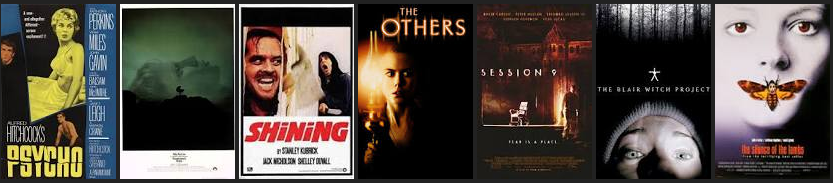
Some well renowned psychological horror films include:


•Jacob's Ladder (1990)

•The Shining (1980)

•Black Swan (2010)