Friday, 24 March 2017

TODOROV'S THEORY

Todorov's narrative theory suggests that all narratives have a three part structure where they begin with equilibrium, where everything is balanced, progress as something occurs that disrupts this equilibrium, and finally reach a resolution- when equilibrium is restored. 

There are general steps that the narrative must follow in order to conform to this formula:

Step 1:The narrative starts with an equilibrium
Step 2:An action or character disrupts the equilibrium
Step 3:A quest to restore the equilibrium begins
Step 4:The narrative continues to a climax
Step 5:Resolution occurs and equilibrium is restored.


Unconventioanl narratives
Non-linear narratives and circular narratives have a structure that is not so straight forward. A non-linear narrative can move backwards and forwards in time usually using a flashback technique. For example in the film "500 days(of summer" the film follows a relationship but the audience sees flashforwards and flashbacks as the story progresses. 

A circular narrative may begin at the end of the story and work its way back to the origins of the story. The resolution and understanding of the narrative is generally only comprehended by the audience towards the end of the story.

Flashbacks
Flashbacks are used to give the audience additional information, most commonly in regards to the past of a character, which helps drive the narrative. Flashbacks also manipulate space and time.

Point of view shots
These give the audience the same view of the situation and action occurring as a character. An example of this would be a point of view shot of the shark from the Jaws movies. These shots are particularly effective in horror films from the point of the killer usually stalking the victim. Following them until they meet their fate.

Impossible posistions
These are camera shots that are designed to give unusual perspectives of the action unfolding on screen, this can be achieved through the likes of an aerial shot 

Priviledged spectator positions
This is where the camera places the audience in the position where the viewer sees certain aspects of the narrative that other characters cannot see. This is commonly used in murder and detective dramas where the audience know particular information that some of the characters may not know - making it clear who the villain is.

Enigma codes
This is an editing technique in which the camera shows only some of the narrative, leaving the audience with a sense of mystery as to where the narrative will go next.

Murder mystery and detective dramas use enigma codes to slowly reveal the narrative, with key information needed to solve the case saved until near the end of the narrative to create a thrilling conclusion.

Action codes
These are actions within the narrative that reveal to the audience what to expect as the narrative progresses, it relies on the idea of cause and effect.


Thursday, 23 March 2017

POST PRODUCTION EDITING

After filming all of our footage, the most important element of our coursework came into play. Using the Final Cut Pro X (FCPX) software on the Macs, we edited both visual and audio effects, and finalised our film opening over a long period of weeks.

These are the main areas and tools of FCPX:


Of course, the first thing we had to do was choose our final clips and put them in order  across the editing time line. Soon after this, I added the film production company logo (Hammer) at the start of the clips, as it is best to add this before extra editing such as text and sound overlays, as the positioning in relation to the clips could be shifted after adding extra footage at the start.

The next thing we focused on was sound. As our film opening features no dialogue, sound is a highly important element for our final opening and we needed to work our way through various tracks which would be genre-appropriate as a generally overlay. We decided on these main sound clips, which we accompanied by sounds which would act as an effective jump scare sound, as we felt it was parallel to the urban drama aspects of the film opening, as well as building suspense as the opening draws out:


We also began to gather other sound effects such as footsteps and panicked breathing as the original audio from the footage was not as high quality as we had hoped it to be (-on the main day of filming, the atmosphere was quite windy so there was an excess of extra disruptive sound & white noise.)
I added sound clips at their relevant points, using the correction tool to speed up and slow down footage and/or sound so that they fitted realistically. Additionally, extra sounds and small music clips were placed in order to create extra suspense where necessary:


We then added transitions between various video clips to differentiate the separate time framed within the film opening. Instead of having ordinary jump cuts like the central sections of the opening, we used a fade-to-black transition, allowing the audience to infer that the time between the first section with the killer takes place before the sequence featuring the first victim.


Tuesday, 21 March 2017

PRODUCTION- MISE EN SCENE

Of course, a main element to include within our final film opening was mise en scene. We feel as though we have managed to accomplish this in many ways, including the mask, missing poster and other more implicit items throughout the sequence.

This video assists our explanation on how the use of small props and setting has an influence on how the audience views the character.


This video explains how the poster has a large influence on the rest of the film opening, and how the smallest added prop could change the entire plot.


Monday, 13 March 2017

PRE-PRODUCTION SURVEY

In order to get more ideas for our film opening which would appeal to a specific target audience we constructed a small online survey in which people would answer a series of horror genre questions related to our film opening.
These are our results.


Our first simple question asked the age group each participant fell into. Although this seems like an unnecessary question, it helped us decide what our target audience would be for our film opening.
Clearly, our target audience consists of 16-20 year olds, so we must make sure that the opening is suitable for this age group.


 This question also helped us look at how frequently horror films are watched by our target audience so that we were then able to ensure that this specific target audience would be relevant when creating our opening. A fair amount of our answers claimed to have watched several horror films in the recent time span, so the target audience is a good group of people to base the aspects of our opening around.


This question helped us decide whether we should stick with the codes and conventions of slasher horror and film using a traditional male antagonist or female. The vote was equal for both male and female so we decided primarily to have two killers(one of each gender) but after looking through our footage we came to the conclusion that it wasn't clear that there were two killers so we decided to just have one Killer.


From this question we can gather that the killers history and back story are the most popular aspects of the slasher sub-genre. We tried to implement some jump scares in our opening where appropriate.


This question is quite important as a convention which we want to follow is the killer's mask. Because it is a film opening, including a mask with the killer allows the audience to be enticed into knowing who is under the mask. As seen here, the majority of people wanted either a simple white mask, or a gory mask. However, we feel that a plain white mask is too basic and possibly even cliche, therefore we will put some effort into designing and making our own gory mask. This will also be an important mise en scene and narrative element in the storyline.


Location is of course an important element of our film opening, and there are many various types of setting which we could potentially use. However, those who took the survey suggested an isolated town, closely followed by an isolated urban setting. When location scouting, we felt that having an urban setting would be more atmospheric, as well as being a setting in which both our first victim and antagonist would be able to fit into.

Thursday, 2 March 2017

FILM INSTITUTIONS

When we edit out final film opening, we will need to include a relevant film institution at the beginning as this will give the audience an insight to the film genre before it starts.
Of course, there are many different film institutions which could be relevant to our genre, so I have researched several possible institutions which we could use.

Warner Brothers


Founded in 1923, Warner Bros. Pictures are one of the most world renowned film institutions, creating between eighteen to twenty-two films per year. The institution involves a wide range of genres amongst the films which they release, therefore we could potentially use them for our film opening, however it would be better for us to find an institution which focuses on a more specific branch of genres.


20th century fox


20th Century Fox have a wide variety of genres also throughout their releases; however it could be argued that their main focus is on fantasy and occasionally action films commonly featuring binary good vs bad characters within them. The film institution most appeals to the age range of around 10+ years old, as although some themes within the films released are mature, they feature family appropriate themes mostly. I don't think we will use this institution as our film opening isn't what would be considered as 'family friendly' due to suggested and featured violent themes.

Universal


Universal Studios is a film studio which releases a broad genre of films, from children-friendly to horror, however there is a main focus amongst the institution of action, science fiction, and commonly horror, allowing a general age range of approximately 16 and up, obviously depending on the genre used. Universal could be appropriate, however part of our film opening features an urban drama style, thus may be too independent for the themes presented by universal.

Hammer


Hammer Pictures is a British film institution based in London, and was founded in 1934. The production company is well known for a gothic series ‘Hammer Horror’ films made from the mid-1950’s to 70’s. They are also renowned for such films as Dracula, Frankenstein, and The Mummy. The company has a main focus on the horror genre, featuring a variety of different horror sub-genres, including thriller horror- the closest genre relating to our final film opening. Therefore, we are highly likely to use Hammer as the institution for our opening.


Lionsgate


Lionsgate is a Canadian entertainment institution, formed in Vancouver, 2007. The most commercially successful independent film and TV distributor is Lionsgate, as they have produced and distributed over 200 films since they began. Again, the genre focuses on multiple genres of film, although they are considered as being more serious than that of the afore mentioned institutions, possibly being a suitable institution for our film opening.


Twisted pictures


Twisted Pictures is an independent American production company, founded in 2004. They are best known for their horror releases, such as the SAW series. This institution may be considered as one of the most suitable for our film opening, however it may also be too related to body horror- our film opening is possibly not ‘violent’ enough to suit the institution.


In addition to this, we thought it would be a good idea to add a frame which shows evidence of our own 'institution', clearly showing the audience that the film opening was created by us. It is simple, yet still allows the audience to see that the film opening is created by us.


Tuesday, 7 February 2017

WORK LOG- FILMING

Once we were sure that all of our planning was in order, we set a filming date and eventually began filming our coursework.

Day one

We all met at Imogen's house as this was the first filming location. Here we did the makeup for both actresses, one being the sfx of the cut face and the other being the character make-up (eye shadow,lipstick etc)[see special effects makeup post]. We filmed the receiving of the text and the gathering of the possessions in the bedroom, which included close ups of the eyes, phone, and the items that the first victim gathers. We encountered problems with the lighting as it was somewhat a yellowish hue, in contrast to the darkness outside (thus we were unable to use natural lighting), however we resolved this by using extra artificial lighting. 


The montage of the character getting ready took many shots to film at first in order to get the match on action just right. Then we filmed the shots of her tying her shoelace and exiting the house to complete the 'getting ready' process. After completing the match on action shot with the front door, we left my house and walked across the road to the starting point of our next location.


Next, we filmed the walking shots of Katya as her character walks towards where she suspects she is receiving drugs. We had to use artificial lighting as it was very dark outside, and the street lights wouldn't provide enough lighting to make the character visible. Once this was filmed, we carried on to the overpass bridge which we would film the capturing scene. Luckily, the bridge remained unoccupied throughout filming, so we were able to complete filming the sequence quite quickly, although we were rather anxious regarding members of the public's reactions towards our mise en scene mask and camera equipment out on show.
By placing the camera behind a tree, we were able to film a POV shot of the killer looking across the road at the first victim. 


Additional filming
After we had reviewed all of our footage from the first filming session, we decided that we need additional footage to tie to the opening together. We felt that we needed more clips of the killer to cue the audience in to his motive, as it wasn't particularly clear as to what he wanted. To create the ideal atmosphere for the killer to be in- we filmed the additional scene in our school's dark room which contains red lights that we believe successfully convey the feeling of danger as well as adding to the whole 'blood and gore' aesthetic.


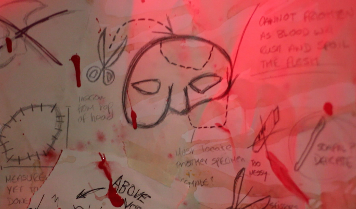
We made plans/blueprints of he mask that the killer would use as guidelines and we put them on the wall and put our killer in front of them. We filmed our killer holding the piece of flesh up to the plans, him putting on his mask, drawing lines on his victims face and finally washing his hands. The footage filmed here is (what we consider) as better quality than the other footage as the lens used was different and specifically for video in comparison to the previously used lens.


Thursday, 2 February 2017

TYPOGRAPHY RESEARCH

To work out the most appropriate movie typography I looked at movie typography that I consider relate to our genre and premise.

Saw
The film saw is notorious for it's graphic body horror and immense amount of violence. The typography for the majority of the films (with the exception of saw 5) have the same font with something next to it which makes it have its own identity. The colour of the typography is dark and messily done, which reflects the gory and disgusting nature of the films and suitable for the content within the movie. This film relates to our opening as it shares similarities with the body horror violence.
Friday the 13th

The famous slasher film "Friday the 13th" has font that looks like it has been carved out of something which is suitable and Mrs Vorhees and her son Jason (in the later films) carve up humans with many weapons - most notably Jason's famous machete. The blood splattered 13th successfully shows the audience what kind of film it's going to be as there is a lot of blood within the movie. If we were to take an aspect from this typography and implement it into our typography we would use the blood as several shots of our opening contain blood.

Nightmare on Elm Street

The typography for "Nightmare on elm street" is blood red, which is suitable as the movie contains quite a lot of it. Unlike Friday the 13th the entire title of the film is in red so it stands out. The nightmare is in a different font to the rest of the title and it arguably heightens the appeal of the film as viewers will want to know what is so nightmarish about this film to have a title like that. We would, as I said in the Friday the 13th part, use the red of the title.

House of the dead

The house of the dead typography is of particular interest because it looks like it has been written with blood with it splattered along the bottom of the title. Just like the others it is suitable for the film. We would definitely take inspiration from this typography as I feel it would be suitable for our film opening.